
Understanding (and Celebrating) Girls Who Learn Differently
March 8, 2026
What is Executive Functioning? Strategies to Try at Home and In School
March 19, 2026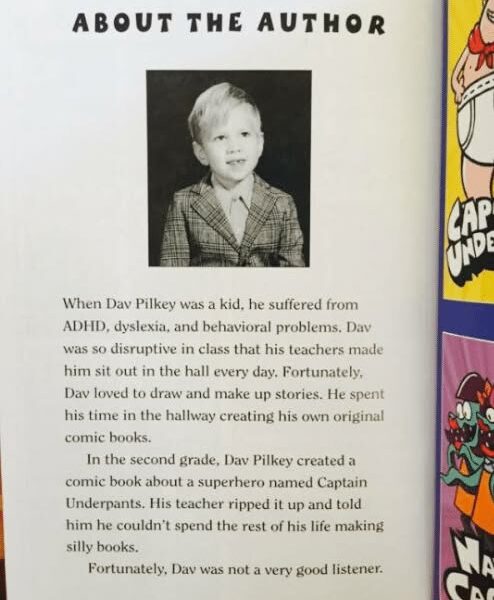
From the Hallway to the Bestseller List: What Author Dav Pilkey Teaches Us About Learning Differences
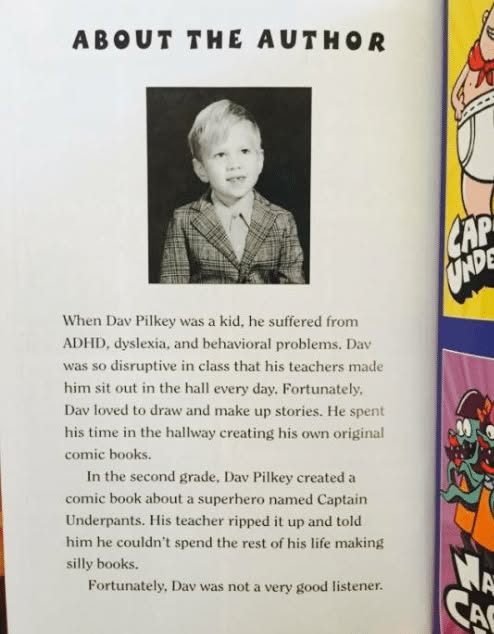
If you have a young child at home, chances are you’ve come across a book authored by Dav Pilkey. My 7 year-old son is obsessed with the Captain Underpants and DogMan books. And when I read with him, I can see why! The stories are goofy and hilarious. While my son is still trying to decode all of the words, these graphic novels keep his interest and his enjoyment of reading grows.
The “About the Author” page is the same in each book. The first time I read it, I chuckled but also wondered about Dav’s experience as a young student with ADHD and dyslexia. He would have been in elementary school in the 1970s. What did we know about ADHD and dyslexia at the time? Not as much as we do today!
Although studied for decades, the Diagnostic and Statistical Manual of Mental Disorders (DSM) did not recognize “Attention Deficit Disorder” until 1980 and “Specific Learning Disorder” until 1987. Dr. Sally Shaywitz’s famed ConnecticutLongitudinal Study on dyslexia wouldn’t begin until 1983. ADHD would rise to prominence in the 90's, with Adderall becoming FDA approved in 1996.
A young Dav Pilkey likely would not have been taught by teachers who expertly knew how to differentiate instruction, provide modifications, and set up accommodations for children with learning issues. The assistive technologyoptions that are abundant today were nonexistent. Their teacher preparation programs likely didn’t dive into ADHD and learning disabilities. But as the author states, “Fortunately, Dav was not a very good listener.” To date, he has written 66 books, with multiple adaptations to film and TV stemming from his creative musings as a young child removed to the hallway for being too disruptive.
As Maya Angelou famously said, “Do the best you can until you know better. Then when you know better, do better.” This is true for any professional - psychologists, like myself, included! Today’s teachers are better positioned to support children with diverse learning needs. The future Dav Pilkeys are receiving structured literacy for reading deficits, accommodations and modifications uniquely chosen to hold students to high standards that are also accessible, and assistive technology that enhances a student’s learning. Parents are becoming experts in their child’s preferred modes of learning and advocating for their needs. Recent legislationaround dyslexia is ensuring that students’ reading skills are screened, intervened, and monitored so that they are able to close the achievement gap between their skills and their typical peers.
Education has come a long way in supporting children with ADHD and dyslexia, but the work continues. If you want to grow your knowledge in dyslexia and ADHD, consider the below resources well-liked by our Diagnostic Center psychologists.
- Overcoming Dyslexia, 2nd Edition by Sally Shaywitz (there is also a free course by the same name on Coursera.org)
- ADHD 2.0 by Edward M. Hallowell and John J. Ratey
- International Dyslexia Association, dyslexiaida.org
- Understood.org is a valuable resource to help parents and children understand their diagnoses, as well as how to support needs in the school setting.
Thank you to Molly Bernosky, Diagnostic Center Director, Springer School and Center for sharing these insights.